
Follow Me On Social Media!
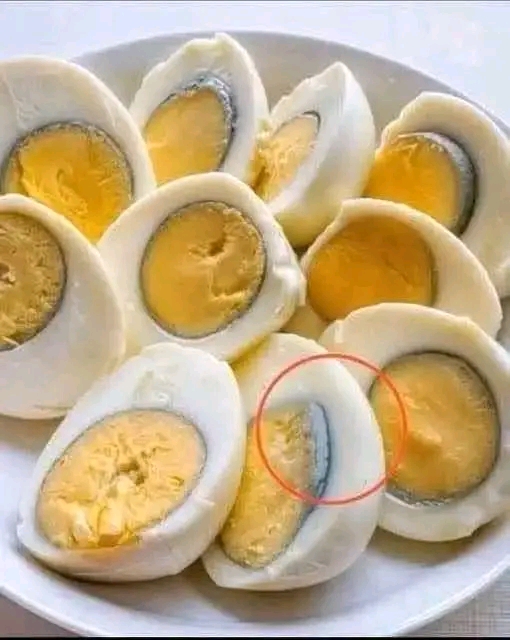
Why Does a Green Ring Appear Around Hard Boiled Eggs

1. What the green ring actually is
The green or grey ring that appears around the yolk of a hard‑boiled egg is typically due to a compound called ferrous sulfide (also called iron sulfide). At the boundary between the egg white and yolk, sulfur released from the white combines with iron from the yolk, resulting in a deposit of ferrous sulfide, which has a greenish‑gray colour.
In more detail: the egg white contains sulfur‑bearing amino acids (such as cysteine, methionine) which, when heated sufficiently, release hydrogen sulfide (H₂S) gas. Meanwhile, the yolk contains iron in various forms. The hydrogen sulfide migrates toward the yolk / boundary and reacts with iron to form the greenish ring of ferrous sulfide.
It generally appears at the interface of the yolk and white because that’s where the sulfur gases emanating from the white reach the iron‑rich yolk.
Because the colour is purely a chemical change and not a sign of spoilage, the egg is still safe for consumption.
2. Why the reaction happens (time, temperature, chemistry)
a) Overcooking
One of the main drivers for the formation of the green ring is overcooking the egg. The longer the egg is subjected to high heat, the more the egg white’s proteins break down and release sulfur, the more hydrogen sulfide is generated, and thus the more iron in the yolk is triggered to react.
According to one source: “The #1 cause is cooking the eggs too long. Even 5–10 minutes past ideal time can trigger the sulfur‑iron reaction.”
b) High temperature / rolling boil
Cooking at a high, vigorous boil tends to raise internal egg temperatures more rapidly, and may encourage extra sulphur release and reaction. A rapid rolling boil can intensify the reaction compared with a gentler simmer.
c) Slow cooling / residual heat
Another contributing factor is the failure to cool the eggs quickly after cooking. If the eggs remain in hot water or in residual heat, the chemical reactions continue even after you think cooking is over. That allows more ferrous sulfide to form at the boundary.
d) Age of egg / pH changes
Eggs change subtly in their chemistry as they age. Fresh eggs are harder to peel, and older eggs have a slightly higher pH in the white, which may influence the reaction rate of hydrogen sulfide release and binding with iron. Some sources note older eggs more easily show the green ring.
e) Iron content in cooking water
Less commonly, the mineral content of your cooking water (especially iron levels) can affect how pronounced the green ring becomes. Water with higher iron content may contribute extra iron to the reaction or accelerate it.
3. Is the egg safe to eat when it has a green ring?
Yes — the green ring is harmless. It’s a visual cue of the reaction described but does not, by itself, indicate spoilage or safety hazard. Many authoritative sources state that eggs with a green ring are still wholesome and fully edible.
However, while the ring itself is safe, the conditions that caused it (e.g., overcooking) may affect taste or texture. Overcooked eggs may have rubbery whites, chalky yolks, and a faint sulfur smell.
So while the discoloration is benign, the experience of eating the egg might be less pleasant. But from a food safety standpoint it’s fine.
4. What the green ring tells you (and when it’s more than that)
When you see the green ring, it’s a kind of indicator of cooking technique more than of egg quality. It tells you that your eggs were cooked at high temperature or for perhaps too long, or perhaps weren’t cooled promptly. It doesn’t necessarily reflect how fresh the eggs were (though that plays a role) or the health of the bird.
You shouldn’t assume the egg was bad or contaminated simply because of the green ring.
That said, if eggs also have unusual smell (strong sulfur smell beyond the norm), slimy texture, or odd shell damage — those are different signs. In the absence of those, the green ring alone isn’t a concern.
5. How to avoid or minimise the green ring (tips & best practices)
If you’d like your hard‑boiled eggs to have bright yellow yolks with no green ring (especially if you’re serving them whole or in deviled eggs), here are practical steps:
- Use an appropriate cooking time. For large eggs, aim for about 9‑12 minutes once the water is boiling or once you’ve reduced from boil to simmer. (Exact time depends on egg size, altitude, starting temperature.)
- Avoid a rolling, violent boil of eggs for the entire time. Instead, bring to a boil, then reduce heat so eggs cook gently. This helps avoid extreme internal temperatures.
- Immediately after cooking, transfer eggs to an ice bath or very cold water to stop the cooking process and cool quickly. This halts the chemical reactions and prevents further green formation.
- Use fresh (but not ultra‑fresh) eggs if possible. Eggs around 5–10 days old often peel more easily and have less extreme reactions. Older eggs may have higher pH and produce more green ring.
- Consider your water. If your tap water has high iron content or is very alkaline, filtering the water or using softly controlled mineral content may help reduce green ring intensity.
- Peel eggs soon after cooling if possible. Although the ring often appears right away, storing peeled eggs for days can make the green ring more visible (due to continued slight reactions or oxidation). Some users report stored peeled eggs developing more green over time.
6. Why aesthetics matter (and when it doesn’t)
From a functional and nutritional standpoint, an egg with a green ring is fine. But from a presentation standpoint (salads, deviled eggs, catering) you may prefer eggs with bright yellow yolks and no coloured ring. So while the ring doesn’t matter for safety, it might matter for food presentation.
Also, because overcooking or too‑vigorous boil can affect texture and flavour, you may notice subtler differences: whites might be more rubbery, yolks might be chalky rather than creamy. That could matter if you’re serving the eggs in a context where texture counts.
7. Bonus: What the green ring is not — avoiding mis‑interpretations
It’s important to clarify to avoid confusion:
- The green ring is not a sign of spoilage or bacterial contamination by itself. The colour change is chemical, not microbial.
- The green ring is not caused by peeling the egg too roughly, or by staining from cookware in typical situations. The core cause is the sulfur‑iron reaction.
- The green ring is not specific to brown‑shell eggs vs white‑shell eggs; it is independent of shell colour. The shell colour is determined by the hen breed and does not influence the internal chemistry of the egg. Many sources emphasise this.
- The green ring is not an indication that the egg has lost nutritional value significantly. The egg remains a good source of protein, vitamins and minerals. The difference is mostly cosmetic and perhaps textural.
8. Chemistry deep dive (for those curious)
If you like delving into the science:
Egg whites are made up of about 92% water and 8% proteins (with many different protein types, e.g., ovalbumin, ovotransferrin, ovomucoid).
When the egg is heated, proteins denature: the heat causes the globular protein structures to unravel, expose sulphur‑containing amino acids, and the sulphur begins to form compounds such as hydrogen sulfide (H₂S) gas. The temperature threshold is about 70 °C or slightly above for significant hydrogen sulfide generation.
The yolk contains iron in forms associated with proteins and pigments. Iron is present in the yolk partly as part of the heme pigments and other iron‑binding proteins. When hydrogen sulfide migrates to meet the iron, ferrous sulfide (FeS) forms, which is greenish or grey. The ring forms at the interface because that is where the white’s sulphur compounds can reach the yolk’s iron.
The reaction can be represented (in simplistic form) as:
Though in reality internal egg chemistry is more complex and involves complex protein breakdown and diffusion. The visual result: a thin green‑grey layer around the yolk.
9. Practical scenarios & troubleshooting
Here are some common scenarios and how to interpret them:
- You boiled the eggs for, say, 15 minutes at a strong rolling boil and then let them sit in hot water for another 10 minutes. You cut one open and see a dark green ring around the yolk. Interpretation: Overcooked and residual heat allowed further reaction. These eggs are safe, but texture may be less than ideal. Prevent next time by reducing cook time and cooling promptly.
- You boiled eggs but did not chill them immediately; you let them sit in the pot off‑heat for 5 minutes before cooling. You get a faint green ring. Interpretation: Cooling was delayed—residual heat kept reaction going. Next time: transfer to cold water right away.
- You used older eggs (e.g., 2‑3 weeks old) and you get a greenish tinge even though you used standard cook time. Interpretation: Older eggs may have more pronounced reaction because of higher pH or other changes. Using slightly fresher eggs might help, or adjusting timing.
- You boiled eggs and although the centre yolk looks fine, you store peeled eggs in the fridge overnight and the next day notice the green ring is more pronounced. Interpretation: Even after cooking, slight chemical reaction may continue if eggs remain warm or if internal temperature remains high. Also storage can affect appearance. Solution: ensure full cooling, store unpeeled if possible, peel close to serving time.
- You see green/yellow ring but also notice a strong rotten‑sulfur smell (beyond normal) or slime on the egg white. Interpretation: That may be spoilage or bacterial growth, rather than the benign ferrous sulfide ring. In such cases, discard. The green ring alone, without other signs, is fine.
10. Summary and key takeaways
- The green ring around the yolk of a hard‑boiled egg is caused by a chemical reaction: sulfur from the white + iron from the yolk → ferrous sulfide (greenish/grey).
- It typically happens when eggs are overcooked, boiled too aggressively, or left too long before cooling.
- The ring is not harmful — the egg is safe to eat, albeit the texture/taste might be somewhat affected if overcooked.
- To minimise the green ring and get a bright yellow yolk: cook for an appropriate time, use gentler heat, immediately cool the eggs in cold water, consider water quality and egg age.
- The green ring is a cosmetic and cooking‑technique indicator, not a sign of bad egg or health risk.